Picking an LLM by time to finish the task, not tokens per second
Tokens per second is a misleading speed number for LLMs. A reasoning model can stream at 200 tok/s and still take longer to answer than a 60 tok/s model, because it burns ten times as many thinking tokens before it gets there. What you actually wait for is:
minutes per task = output tokens per task / output tokens per secondArtificial Analysis publishes both numbers for every model and reasoning-effort variant it benchmarks: the median output speed and the tokens each variant spends on an Intelligence Index task. Dividing them gives a speed metric that penalizes verbosity, so a model that thinks with 3x more tokens at 2x the speed correctly shows up as slower. With that on one axis and the Intelligence Index on the other, you can draw a Pareto frontier: the set of models where nothing else is both smarter and faster.
The speed frontier
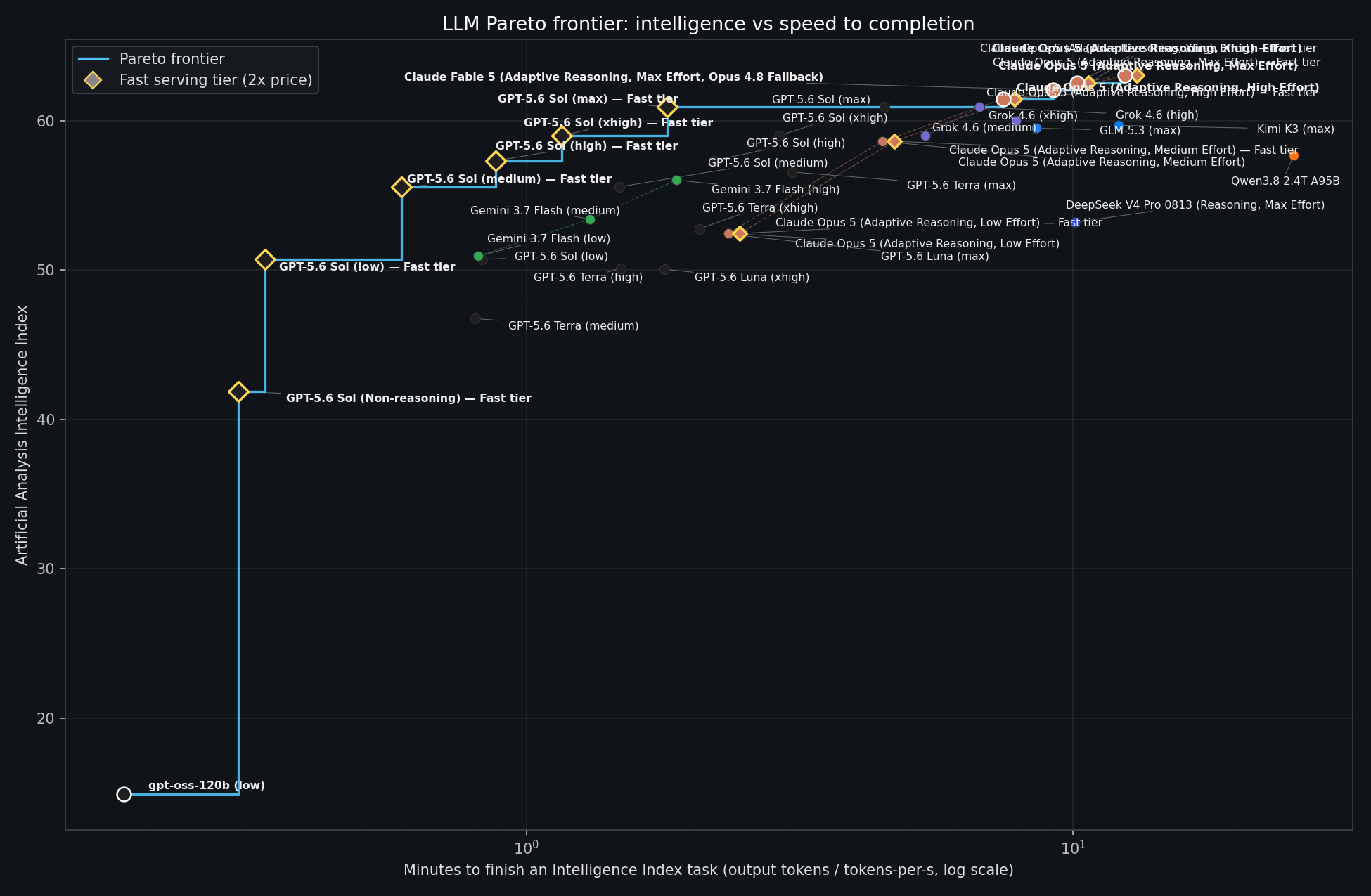
The frontier splits in two. GPT-5.6 Sol's fast tier owns everything under two minutes: II 50.7 at 0.33 min on low effort, up to II 60.9 at 1.8 min on max. Above that, Claude Opus 5 takes over, ending at II 63.1 at 12.5 min on max effort. The gap in the middle is the real decision: Opus max buys you 2.2 II points over Sol Fast max and costs you 7x the wall-clock time.
Fast serving tiers
Providers now sell fast serving modes that run the same weights on faster infrastructure, so intelligence and token counts are unchanged and only tokens/s and price move. Artificial Analysis does not benchmark these, so we synthesize them from two evidence sources:
- Measured: OpenRouter publishes per-endpoint throughput stats. Claude Opus 5 Fast runs at a p50 of 94 tok/s vs 32 tok/s on the standard Anthropic endpoint, a 2.9x ratio at 2x price.
- Vendor-claimed: OpenAI documents Fast mode (renamed from priority processing in July 2026) as up to 2.5x faster for GPT-5.6 Sol at 2x price. No independent measurement exists yet, so the point is marked as vendor-claimed.
No other fast tier gets invented. Models like Gemini Flash or Grok Fast are distinct models with their own benchmark scores, not serving tiers, and they already appear as their own points.
The cost frontier
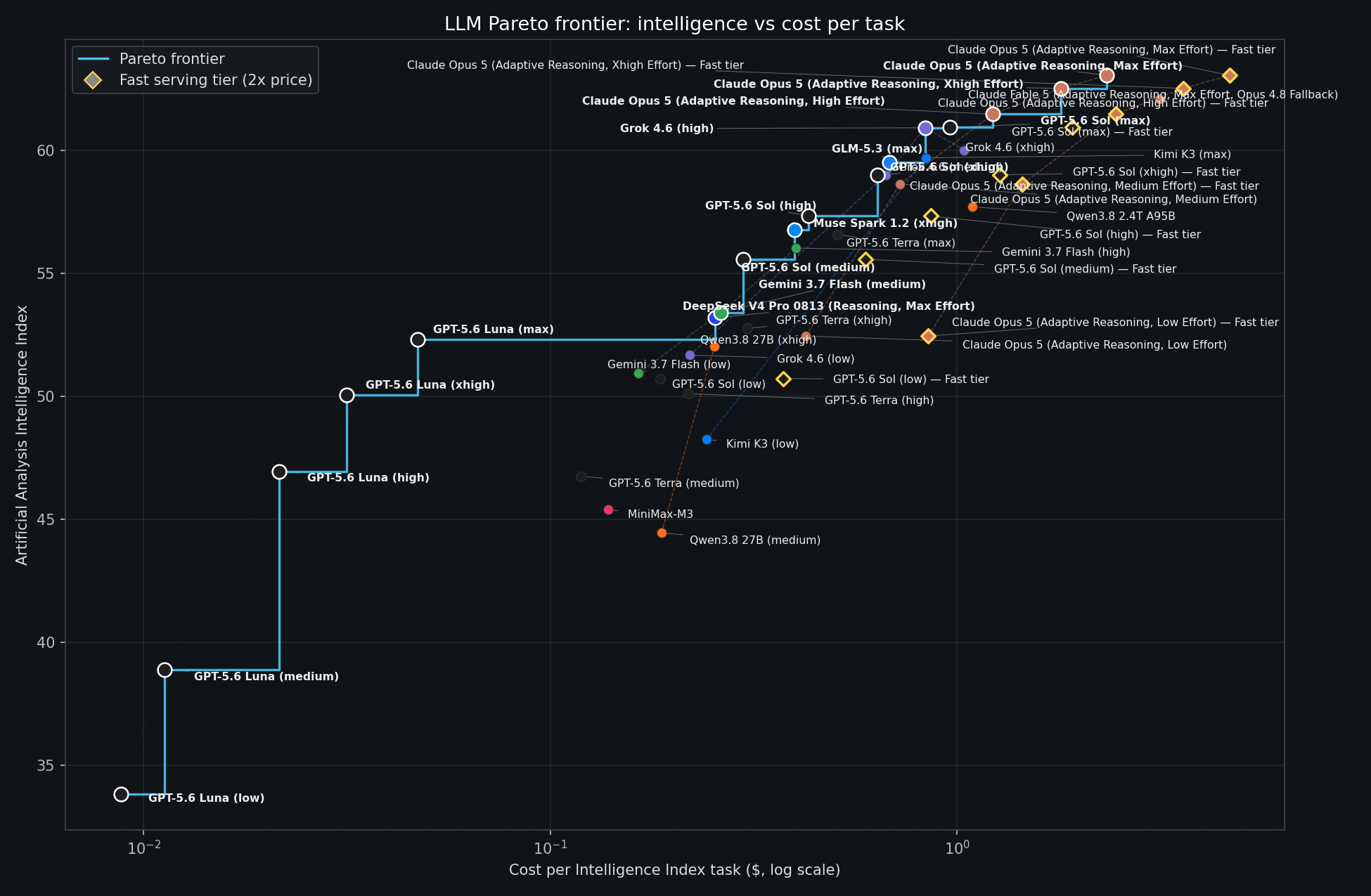
The cost cut looks completely different. GPT-5.6 Luna owns the cheap end, from II 33.9 at $0.009/task to II 52.3 at $0.047/task, roughly 1/50th the cost of anything comparable. The mid-range belongs to DeepSeek V4 Pro, Gemini 3.7 Flash and GPT-5.6 Sol, with GLM-5.3 and Grok 4.6 around $0.7 to $0.8, and Opus 5 topping out at $2.34/task. Fast tiers never make this frontier: same intelligence at 2x price only wins on the speed axis.
One surface, three axes
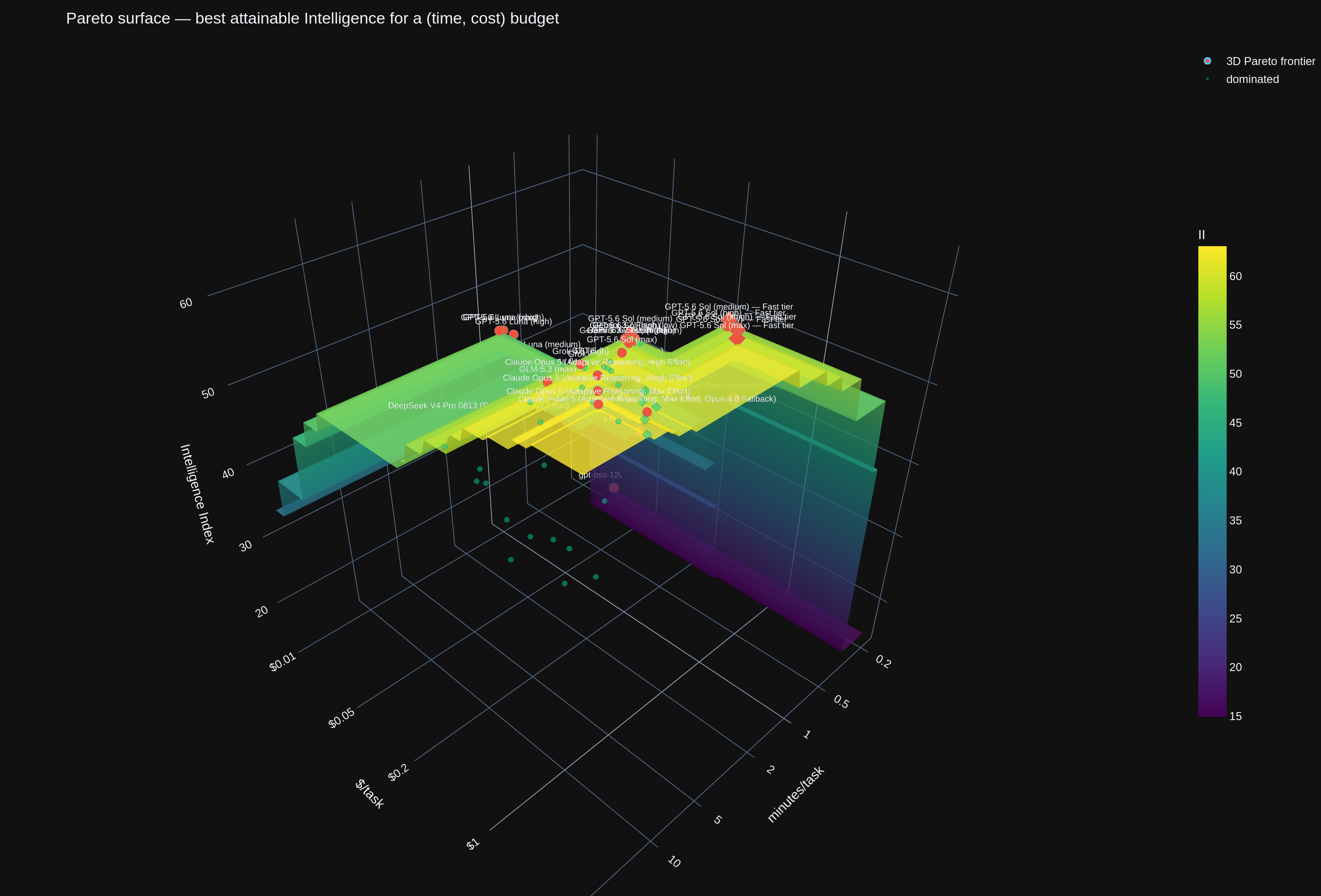
With three objectives, plain Pareto dominance stops filtering much: about 60% of variants are non-dominated, because one wins on time, another on cost. To actually pick a model you need to say how much an intelligence point is worth to you. We use a log-linear utility:
score = II/τ − wt·ln(minutes/task) − wc·ln($/task)Time and cost are ratio quantities, so 2x cheaper is worth the same at any price level and belongs in a log. Intelligence points are roughly linearly valuable. τ then reads as "τ extra II points justify an e-fold (~2.7x) larger time or cost budget". Whatever weights you choose, the maximizer is always on the Pareto surface; the weights only pick where on it you land.
What to run, per use case
- Cost barely matters: Claude Opus 5 Fast on max effort, II 63.1 in 4.3 min at $4.67/task. If you want it 3x faster, GPT-5.6 Sol Fast max gives up 2 II points for 1.8 min and $2.46.
- Speed-leaning quality: GPT-5.6 Sol Fast, using the effort level as a latency dial. Medium is II 55.6 at 0.6 min, high is 57.3 at 0.9 min, max is 60.9 at 1.8 min.
- Cost efficiency: GPT-5.6 Luna on high or xhigh effort, II 47 to 50 at $0.02 to $0.03 per task.
- Subagents (many parallel calls, need fast + cheap + decent): GPT-5.6 Sol Fast low at 0.33 min and $0.46 if wall-clock latency is the bottleneck; Gemini 3.7 Flash low at 0.7 min and $0.16 if cost is; Luna high if cost dominates everything.
Reproducing this
The whole analysis is a single deterministic script published as an agent skill in talayolabs/skills. It parses the full ~600-variant dataset embedded in Artificial Analysis's public pages (no API key), pulls fast-tier throughput from OpenRouter, and recomputes every chart, table and ranking above on demand:
python3 pareto_frontier.py --efforts            # speed frontier
python3 pareto_frontier.py --x cost             # cost frontier
python3 pareto_frontier.py --surface out.html   # 3D surface
python3 pareto_frontier.py --profile subagent   # ranked picks
Benchmarks move fast; the numbers above are an August 2026 snapshot. The frontier is cheap to re-derive, so re-run it before committing to a model.